Published on PeptideLab | Read time: 12 min | Last updated: October 2026
The Triple Mechanism That Changes Everything
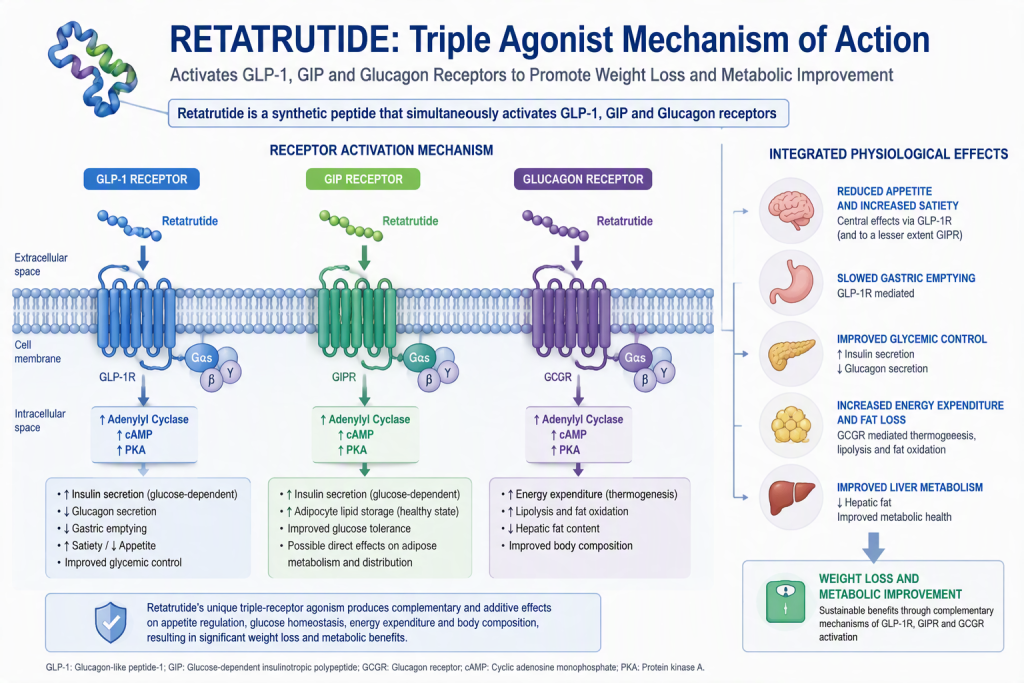
Retatrutide’s effectiveness doesn’t come from a single clever trick—it comes from attacking obesity through three complementary biological pathways simultaneously. Most weight-loss medications target one or two hormonal systems. Retatrutide targets all three major incretin receptors, creating a synergistic effect that neither approach can achieve alone.
Browse our full peptide catalog
Understanding how this works requires looking at each receptor system individually, then examining how they interact when activated together.
GLP-1 Receptor: The Appetite Regulator
What Is GLP-1?
Glucagon-like peptide-1 (GLP-1) is an incretin hormone naturally produced in your intestines after eating. It’s part of your body’s “cephalic phase” response—meaning it starts working before food even reaches your stomach.
When GLP-1 binds to its receptors, it triggers several cascading effects:
Central Nervous System Effects:
– Acts on the hypothalamus to reduce hunger signaling
– Increases satiety signals—your brain tells you you’re full sooner
– Modulates the reward centers, making high-calorie foods less appealing
– Slows gastric emptying, keeping you fuller longer
Peripheral Effects:
– Stimulates glucose-dependent insulin secretion from pancreatic beta cells
– Suppresses inappropriate glucagon release
– Delays gastric emptying, creating mechanical fullness
– Promotes beta-cell proliferation and reduces apoptosis
Why GLP-1 Alone Isn’t Enough
GLP-1 agonists like semaglutide have transformed obesity treatment, achieving 15-20% weight loss in clinical trials. But there are limitations:
- Tolerance develops—after months, the appetite-suppressing effect diminishes
- Plateaus occur—weight loss slows after the initial rapid phase
- Side effects limit dosing—nausea, vomiting, and GI distress prevent some patients from reaching optimal doses
- Single-pathway limitation—targeting only one receptor leaves other obesity mechanisms unaddressed
This is why adding GIP and glucagon activation matters.
GIP Receptor: The Metabolic Enhancer
What Is GIP?
Glucose-dependent insulinotropic polypeptide (GIP) is another incretin hormone, co-secreted with GLP-1 after meals. For decades, GIP was considered redundant—its effects seemed to overlap with GLP-1. Recent research has completely overturned this assumption.
GIP’s Unique Contributions:
| Effect | Mechanism | Clinical Significance |
|---|---|---|
| Insulin sensitization | Enhances insulin receptor signaling | Improves glucose uptake without hypoglycemia |
| Lipid metabolism | Promotes fat storage in subcutaneous tissue | Shifts fat away from visceral depot |
| Synergy with GLP-1 | Activates overlapping but distinct pathways | Amplifies GLP-1’s appetite effects |
| Anti-inflammatory | Reduces adipose tissue inflammation | Improves metabolic health beyond weight loss |
The GIP Paradox
Here’s where it gets interesting: GIP’s effects depend on context. In the presence of active GLP-1 signaling, GIP becomes more beneficial. Without GLP-1, GIP’s effects are more modest. This is why tirzepatide (dual GLP-1/GIP agonist) works better than either drug alone.
Retatrutide takes this further by adding glucagon activation on top of both GLP-1 and GIP.
Glucagon Receptor: The Game Changer
What Does Glucagon Do?
Glucagon is traditionally known as the hormone that raises blood sugar—opposite of insulin. But its role in obesity treatment is more nuanced and potentially more powerful than previously appreciated.
Primary Metabolic Effects:
- Hepatic glucose production: Stimulates glycogenolysis and gluconeogenesis in the liver
- Lipolysis: Activates hormone-sensitive lipase, breaking down triglycerides into free fatty acids
- Ketogenesis: Promotes ketone body production during fasting states
- Energy expenditure: Increases calorie burning through thermogenesis
Why Glucagon Activation Matters for Weight Loss
This is where retatrutide diverges significantly from semaglutide and tirzepatide.
The Fat Mobilization Advantage:
– GLP-1 and GIP primarily reduce calorie intake
– Glucagon increases calorie expenditure
– Together, they create a double attack: eat less, burn more
Body Composition Benefits:
– Studies show glucagon activation preferentially targets visceral fat
– Helps preserve lean muscle mass during calorie restriction
– Improves metabolic flexibility—better at switching between carb and fat burning
Cardiometabolic Protection:
– Reduces hepatic fat content (relevant for NAFLD/NASH)
– Improves lipid profile independently of weight loss
– May provide cardiac benefits through improved myocardial metabolism
The Synergy: Why Three Is Better Than One
Pharmacodynamic Interactions
When all three receptors are activated simultaneously, the effects aren’t merely additive—they’re synergistic.
| Combination | Effect | Mechanism |
|---|---|---|
| GLP-1 + GIP | Enhanced satiety | Overlapping CNS pathways amplify fullness signals |
| GLP-1 + Glucagon | Better glucose control | Glucagon’s hepatic effects complement GLP-1’s insulin effects |
| GIP + Glucagon | Improved lipid metabolism | GIP redirects fat storage; glucagon mobilizes it |
| All three | Maximal weight loss | Multiple pathways attack obesity from different angles |
Clinical Evidence
The SURMOUNT program demonstrated this synergy clearly:
- Semaglutide (GLP-1 only): ~15% weight loss
- Tirzepatide (GLP-1 + GIP): ~20-22% weight loss
- Retatrutide (GLP-1 + GIP + Glucagon): ~28% weight loss
Each additional receptor activation added meaningful incremental benefit. The jumps aren’t linear—each new pathway unlocks different biological possibilities.
Dosing and Receptor Occupancy
Gradual Escalation Strategy
Retatrutide uses a careful dose escalation protocol designed to maximize receptor occupancy while minimizing side effects:
| Phase | Dose | Duration | Expected Receptor Activity |
|---|---|---|---|
| Starting | 2 mg | Weeks 1-4 | ~30-40% GLP-1, ~20% GIP, ~10% glucagon |
| Titration 1 | 4 mg | Weeks 5-8 | ~50-60% GLP-1, ~40% GIP, ~25% glucagon |
| Titration 2 | 6 mg | Weeks 9-12 | ~70-80% GLP-1, ~60% GIP, ~40% glucagon |
| Maintenance | 8-12 mg | Ongoing | ~90%+ GLP-1, ~80%+ GIP, ~60%+ glucagon |
Receptor Selectivity
Retatrutide isn’t equally potent at all three receptors. It shows:
– Highest affinity for GLP-1 receptor
– Moderate affinity for GIP receptor
– Lower but therapeutically relevant affinity for glucagon receptor
This selectivity profile appears intentional—too much glucagon activation causes tachycardia and anxiety, while too little provides minimal benefit. The current dosing achieves the “sweet spot.”
Beyond Weight Loss: Systemic Benefits
Cardiovascular Health
GLP-1 and GIP both have cardiovascular benefits independent of weight loss:
– Improved endothelial function
– Reduced blood pressure
– Favorable lipid changes
– Potential anti-arrhythmic effects
Glucagon activation may add:
– Improved myocardial energy metabolism
– Reduced hepatic fat (relevant for NASH-related cardiovascular risk)
Diabetes Remission
The triple mechanism creates conditions favorable for diabetes remission:
– Sustained glucose lowering without hypoglycemia risk
– Beta-cell rest and recovery
– Improved insulin sensitivity
– Reduced hepatic glucose output
Liver Health
Non-alcoholic steatohepatitis (NASH) affects up to 25% of obese individuals. Retatrutide’s mechanism directly addresses this:
– Glucagon activation reduces hepatic fat
– Weight loss improves NASH histology
– Inflammation reduction slows fibrosis progression
Side Effects and Tolerance
Common Adverse Events
The more receptors you activate, the more side effects you may experience:
| Side Effect | Frequency | Mechanism | Management |
|---|---|---|---|
| Nausea | 30-40% | GLP-1 gastric effects | Start low, go slow |
| Vomiting | 10-15% | Gastric delay | Dose reduction |
| Diarrhea | 15-20% | Altered gut motility | Dietary modification |
| Constipation | 10-15% | Slowed transit | Fiber, hydration |
| Fatigue | 15-20% | Caloric deficit | gradual adaptation |
| Injection site reactions | 5-10% | Local irritation | Rotation sites |
The Tolerance Curve
Most side effects follow a predictable pattern:
– Weeks 1-4: Significant nausea, appetite changes, fatigue
– Weeks 4-8: Side effects diminish as body adapts
– Weeks 8-12: Near-complete tolerance for most patients
– Beyond 12 weeks: Minimal ongoing side effects in 80-90% of patients
About 8-10% of patients discontinue due to side effects—lower than early GLP-1 drugs but higher than placebo.
The Bottom Line
Retatrutide’s triple mechanism represents a fundamental shift in obesity pharmacology. By simultaneously targeting appetite suppression (GLP-1), metabolic enhancement (GIP), and energy expenditure (glucagon), it addresses obesity from multiple angles that single-pathway drugs cannot match.
The clinical results—nearly 30% weight loss with favorable body composition changes—reflect this mechanistic advantage. Understanding how these three receptors interact helps explain why retatrutide outperforms its predecessors and why the field is moving toward multi-pathway approaches.
Disclaimer: This article is for informational purposes only. Retatrutide is investigational and not FDA-approved. Consult a qualified healthcare provider for treatment decisions.