Published on PeptideLab | Read time: 10 min | Last updated: October 2026
The Accumulation Problem
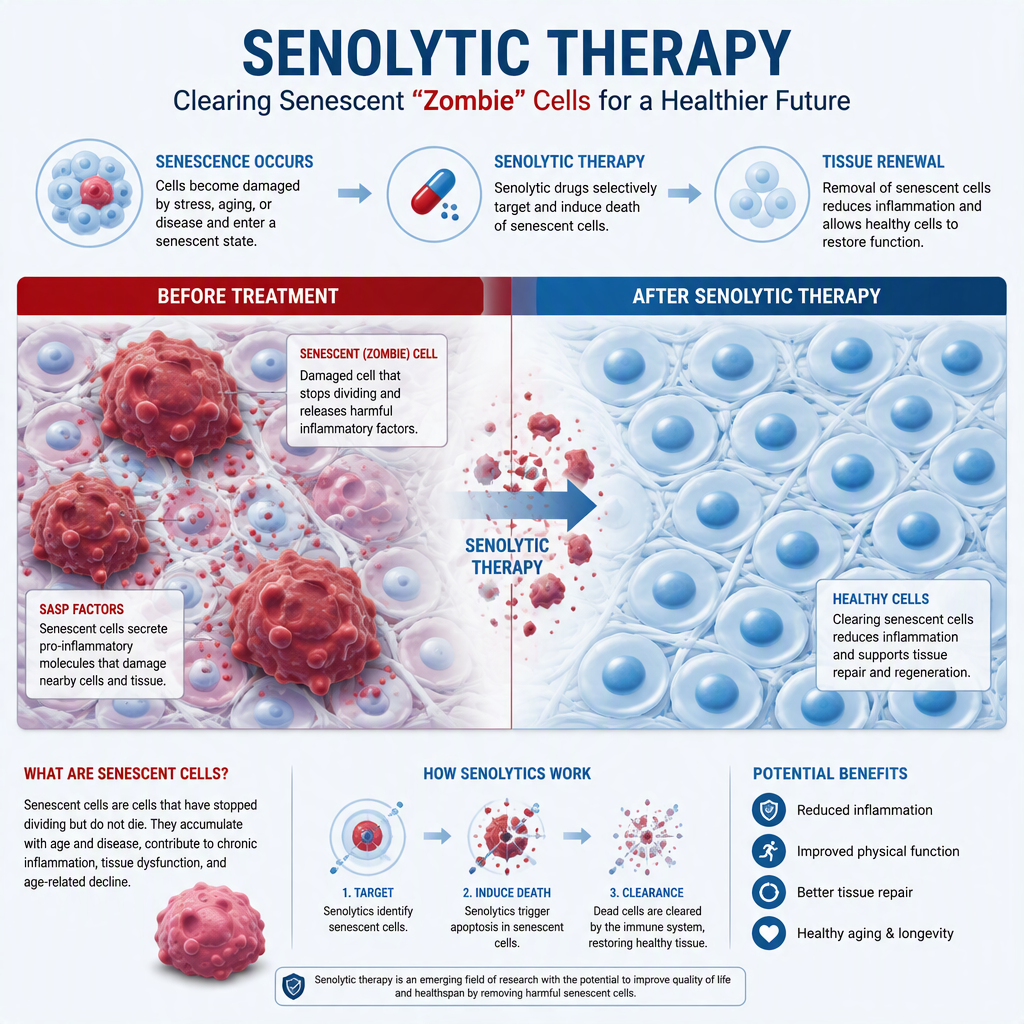
Every day, your body produces billions of new cells. Most live out their natural lifespan and are replaced. But some cells enter a state called senescence—they stop dividing but refuse to die.
Browse our full peptide catalog
These zombie cells accumulate with age, and their presence is linked to virtually every age-related disease.
Cellular Senescence Explained
What Triggers Senescence?
| Trigger | Example | Consequence |
|---|---|---|
| Telomere shortening | Replicative exhaustion | Natural aging |
| DNA damage | Radiation, toxins | Mutation prevention |
| Oxidative stress | Free radical damage | Mitochondrial dysfunction |
| Epigenetic drift | Gene expression changes | Loss of cellular identity |
| Proteostasis loss | Protein misfolding | Cellular stress |
The SASP: The Real Danger
Senescent cells don’t just sit there. They secrete inflammatory molecules called the Senescence-Associated Secretory Phenotype (SASP).
SASP components include:
– Pro-inflammatory cytokines (IL-6, IL-1β, TNF-α)
– Chemokines (recruiting immune cells)
– Proteases (degrading tissue matrix)
– Growth factors (disrupting tissue architecture)
This creates chronic low-grade inflammation—”inflammaging”—that damages surrounding healthy tissue and accelerates aging.
Current Senolytic Approaches
1. Drug Combinations
Dasatinib + Quercetin (D+Q):
– Dasatinib: Cancer drug that kills certain senescent cell types
– Quercetin: Flavonoid that enhances dasatinib’s effect
– Status: Multiple Phase 2 trials completed
– Results: Improved physical function in idiopathic pulmonary fibrosis, diabetic kidney disease
Urolithin A:
– Metabolite of ellagitannins
– Induces mitophagy (removal of damaged mitochondria)
– Status: Available as supplement
2. Natural Compounds
Fisetin:
– Highest concentration in strawberries
– Senolytic at intermittent high doses
– Status: Available OTC, human safety data
– Dosing: 20 mg/kg for 2 consecutive days, monthly
Nanoquercetin:
– Enhanced bioavailability formulation
– Similar mechanism to quercetin
– Status: Available OTC
3. Peptide-Based Senolytics
FOXO4-DNR:
– Disrupts FOXO4-p53 interaction
– Selectively kills senescent cells
– Status: Preclinical only
JNK-I3:
– Another FOXO4-targeting peptide
– Similar mechanism to FOXO4-DNR
– Status: Early research
4. Immunotherapy Approaches
UCAR-NK Cells:
– Universal CAR NK cells targeting senescent cells
– Status: Early preclinical
Senolytic vaccines:
– Training immune system to clear senescent cells
– Status: Very early research
What Animal Studies Show
Research in aged mice has demonstrated remarkable benefits:
| Outcome | Finding | Study |
|---|---|---|
| Healthspan | Extended disease-free lifespan | Nature, 2015 |
| Fertility | Restored in aged males | Nature, 2016 |
| Kidney function | Improved markers | Cell Metabolism, 2018 |
| Physical function | Enhanced running capacity | Aging Cell, 2019 |
| Cancer incidence | Reduced in some models | Nature Medicine, 2016 |
| Fibrosis | Decreased in lung and kidney | Science Translational Medicine, 2017 |
Importantly, benefits were seen in already aged mice—not just prevention in young animals.
Human Clinical Trials
Completed Trials
D+Q for Pulmonary Fibrosis:
– Randomized, placebo-controlled
– Single ascending dose study
– Result: Improved 6-minute walk distance
D+Q for Diabetic Kidney Disease:
– Phase 2 trial
– Result: Reduced fibrosis markers
– Ongoing follow-up studies
Active Trials
| Condition | Intervention | Status |
|---|---|---|
| Idiopathic Pulmonary Fibrosis | D+Q | Recruiting |
| Diabetic Kidney Disease | Fisetin | Phase 2 |
| Alzheimer’s Disease | D+Q | Phase 1/2 |
| COVID-19 Recovery | D+Q | Pilot study |
| Healthy Aging | Fisetin | Multiple Phase 2 |
Practical Considerations
Dosing Protocols
| Compound | Typical Protocol | Frequency |
|---|---|---|
| Fisetin | 20 mg/kg | 2 days/month |
| D+Q | Dasatinib 100 mg + Quercetin 1000 mg | 2 days/month |
| Nanoquercetin | 500 mg | Daily or cyclical |
Monitoring Markers
Track these to assess effectiveness:
– Inflammatory markers: CRP, IL-6, TNF-α
– Senescence markers: p16INK4a, SA-β-gal (biopsy)
– Functional measures: Grip strength, gait speed
– Blood work: Lipid panel, glucose, liver enzymes
Safety Profile
| Compound | Side Effects | Contraindications |
|---|---|---|
| Fisetin | Mild GI upset | None well-established |
| D+Q | Fatigue, nausea | Blood thinners, liver disease |
| FOXO4-DNR | Unknown (preclinical) | N/A |
Who Should Consider Senolytics?
Good Candidates
- Adults over 50 with age-related decline
- Those with elevated inflammatory markers
- People with family history of age-related disease
- Individuals seeking proactive longevity strategies
Not Yet Recommended For
- Young adults without specific indications
- Those with acute infections
- Pregnant or breastfeeding women
- People with uncontrolled chronic diseases
The Science Behind the Hype
What Senolytics Can Do
- Reduce senescent cell burden
- Lower inflammatory markers
- Improve tissue function
- Extend healthspan in animal models
What Senolytics Cannot Do
- Reverse aging completely
- Cure all age-related diseases
- Replace healthy lifestyle
- Guarantee extended lifespan in humans
The Bottom Line
Senolytic therapy represents one of the most promising approaches to addressing aging at its root cause. By clearing zombie cells, we may reduce inflammaging, improve tissue function, and extend healthspan.
FOXO4-DNR offers a targeted peptide-based alternative, but human data is needed. For now, fisetin and D+Q have more clinical backing and are the practical choices for those interested in intermittent senolytic therapy.
The field is moving fast. Stay informed, start conservative, and prioritize lifestyle foundations alongside any intervention.
Disclaimer: Senolytic therapies are experimental. Consult a healthcare provider before beginning any protocol. This article is for informational purposes only.