Published on PeptideLab | Read time: 11 min | Last updated: October 2026
The Underrated Peptide
GHK-Cu gets talked about for skin and hair all the time. But calling it “just a skin peptide” massively undersells what’s happening underneath the surface.
Browse our full peptide catalog
What Is GHK-Cu?
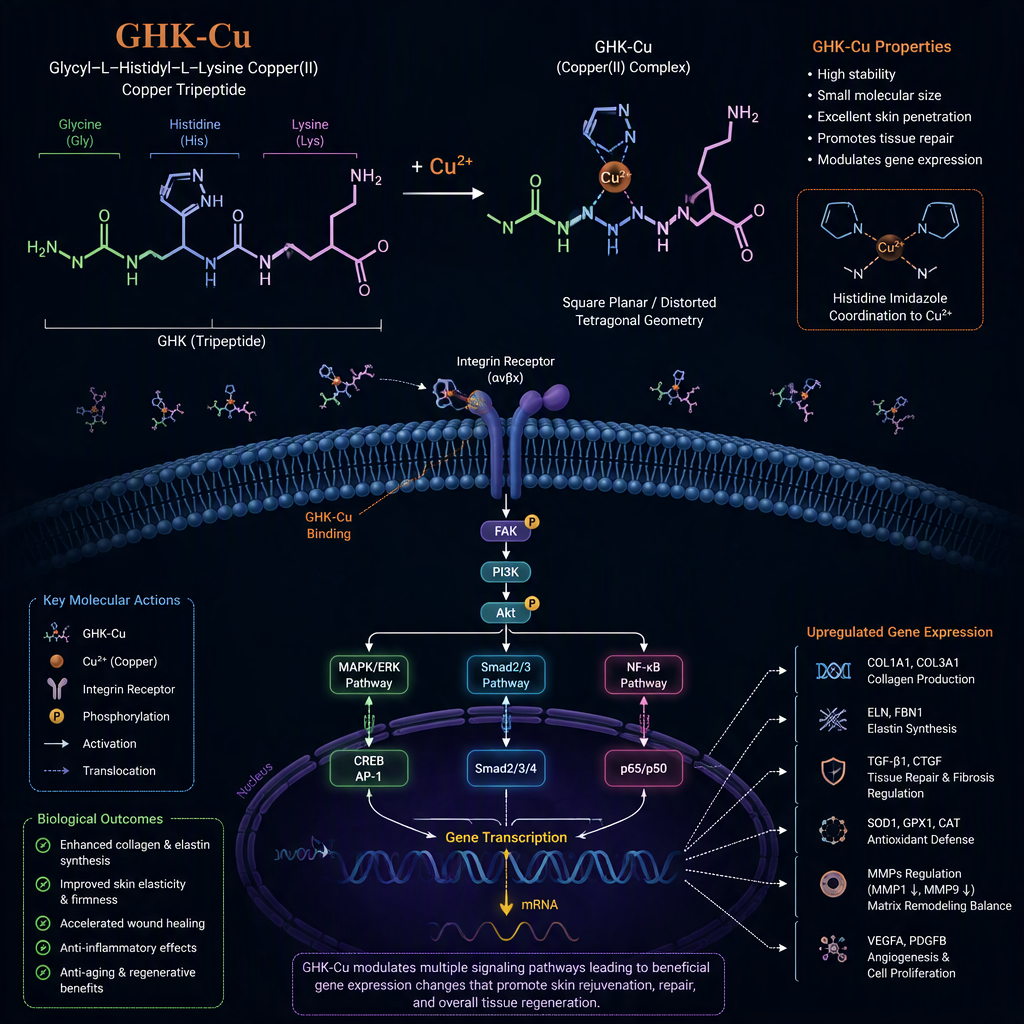
GHK-Cu is a copper-binding peptide—a naturally occurring tripeptide (glycyl-histidyl-lysine) that binds with copper ions. It’s found in high concentrations in plasma, saliva, and cerebrospinal fluid.
The Age Connection
Key fact: GHK-Cu levels decline significantly with age:
– Young adults (20s-30s): ~50 ng/ml
– Middle age (40s-50s): ~30 ng/ml
– Older adults (60+): ~15 ng/ml
This decline correlates with reduced tissue repair capacity, increased inflammation, and accelerated aging.
Five Things GHK-Cu Does
1. Signaling Tissue Repair
GHK-Cu influences fibroblasts—the cells responsible for building and maintaining connective tissue throughout your body.
Mechanism:
– Binds to specific receptors on fibroblast surfaces
– Activates signaling pathways for collagen synthesis
– Promotes extracellular matrix production
– Enhances wound healing at molecular level
This isn’t limited to surface-level healing. The same mechanisms apply to deeper tissue repair, including muscle, tendon, and organ tissue.
2. Supporting Collagen Production
GHK-Cu stimulates collagen and elastin-related activity through multiple pathways:
Collagen Types Affected:
– Type I: Skin, tendons, bones
– Type III: Blood vessels, organs
– Type IV: Basement membranes
– Type V: Hair, cell surfaces
Elastin Support:
– Promotes elastin fiber formation
– Improves tissue elasticity
– Supports vascular health
3. Influencing Inflammation Smartly
GHK-Cu doesn’t simply shut down inflammation. That would be counterproductive— inflammation is necessary for healing.
Modulation vs Suppression:
– Reduces pro-inflammatory cytokines (IL-6, TNF-α)
– Increases anti-inflammatory mediators
– Promotes resolution of inflammation
– Supports proper healing timeline
4. Supporting Antioxidant Defenses
Copper is required for enzymes like superoxide dismutase (SOD), which protects cells against oxidative stress.
Copper-Dependent Enzymes:
| Enzyme | Function | GHK-Cu Role |
|——–|———-|————-|
| Superoxide dismutase | ROS detoxification | Copper delivery |
| Cytochrome c oxidase | ATP production | Electron transport support |
| Lysyl oxidase | Collagen cross-linking | Tissue strength |
| Dopamine beta-hydroxylase | Neurotransmitter synthesis | Brain health |
| Tyrosinase | Pigment production | Skin/hair color |
5. Influencing Gene Expression
This might be the most overlooked aspect. Research suggests GHK can affect the expression of roughly 4,000 genes associated with:
– Tissue remodeling
– Inflammation regulation
– Antioxidant activity
– Collagen synthesis
– Cellular repair
That’s an extraordinary number of genetic interactions for a single peptide.
The Copper Connection
GHK-Cu’s mechanism is unique because it delivers copper—a critical trace mineral—to where it’s needed:
Why Copper Matters:
– Essential cofactor for 30+ enzymes
– Critical for energy production
– Important for connective tissue integrity
– Required for neurological function
– Supports immune function
The Delivery Problem:
Many people have adequate dietary copper but poor cellular uptake. GHK acts as a copper chelator, transporting it across cell membranes efficiently.
Beyond Skin: Systemic Effects
| System | GHK-Cu Effect | Clinical Relevance |
|---|---|---|
| Skin | Collagen synthesis, wound healing, elasticity | Anti-aging, scar reduction |
| Hair | Follicle remodeling, growth promotion | Hair loss treatment |
| Bones | Osteoblast activity, fracture healing | Osteoporosis support |
| Lungs | Tissue repair, fibrosis reduction | COPD, pulmonary fibrosis |
| Liver | Regeneration support, fibrosis reduction | NAFLD, hepatitis |
| Brain | Neuroprotection, repair signaling | Cognitive health |
| Blood vessels | Angiogenesis, repair | Cardiovascular health |
| Immune system | Modulation, regulation | Inflammation control |
Administration Methods
| Method | Bioavailability | Best For | Practical Considerations |
|---|---|---|---|
| Topical | Moderate | Skin, hair applications | Easy, minimal side effects |
| Injectable | High | Systemic effects, deeper tissue | Requires skill, more effective |
| Oral | Low (degraded) | Generally not recommended | Poor absorption |
Topical Application
For Skin:
– Concentration: 1-3% GHK-Cu serums
– Frequency: Once or twice daily
– Results: 3-6 months for visible improvement
For Hair:
– Concentration: 1-2% solutions
– Frequency: Daily application
– Results: 4-8 months for regrowth
Injectable Approach
Protocol:
– Dose: 1-3 mg subcutaneously
– Frequency: 2-3 times per week
– Sites: Abdomen, thigh, upper arm
– Duration: 8-12 weeks cycles
Advantages:
– Bypasses digestive degradation
– Higher systemic concentrations
– Faster onset of action
Safety Profile
GHK-Cu has an excellent safety profile across decades of use:
Known Side Effects:
– Injection site reactions (rare with proper technique)
– Mild redness or itching
– No serious adverse events reported in decades of use
Contraindications:
– Known copper allergy (rare)
– Wilson’s disease (copper overload disorder)
– Pregnancy/breastfeeding (insufficient data)
Stacking Combinations
| Stack | Synergy | Rationale |
|---|---|---|
| GHK-Cu + BPC-157 | Enhanced tissue repair | Different mechanisms, complementary |
| GHK-Cu + Vitamin C | Collagen synthesis support | Vitamin C is cofactor for collagen |
| GHK-Cu + NAC | Antioxidant amplification | Glutathione precursor + copper delivery |
| GHK-Cu + Peptide hormones | Growth factor support | May enhance regenerative effects |
The Bottom Line
Calling GHK-Cu a skin peptide is like calling the internet a telephone. Yes, it helps your skin—but the mechanisms underneath are far more comprehensive. From gene expression to antioxidant enzyme support to tissue remodeling signaling, GHK-Cu operates at multiple levels of cellular regulation simultaneously.
Its copper-delivery mechanism solves a real biological problem: many people are copper-deficient at the cellular level despite adequate dietary intake. GHK-Cu addresses this deficiency while providing pleiotropic benefits across multiple systems.
Disclaimer: This article is for informational purposes only. GHK-Cu is generally recognized as safe but should be discussed with a healthcare provider before use.