Published on PeptideLab | Read time: 10 min | Last updated: October 2026
The Zombie Cell Problem Most People Ignore
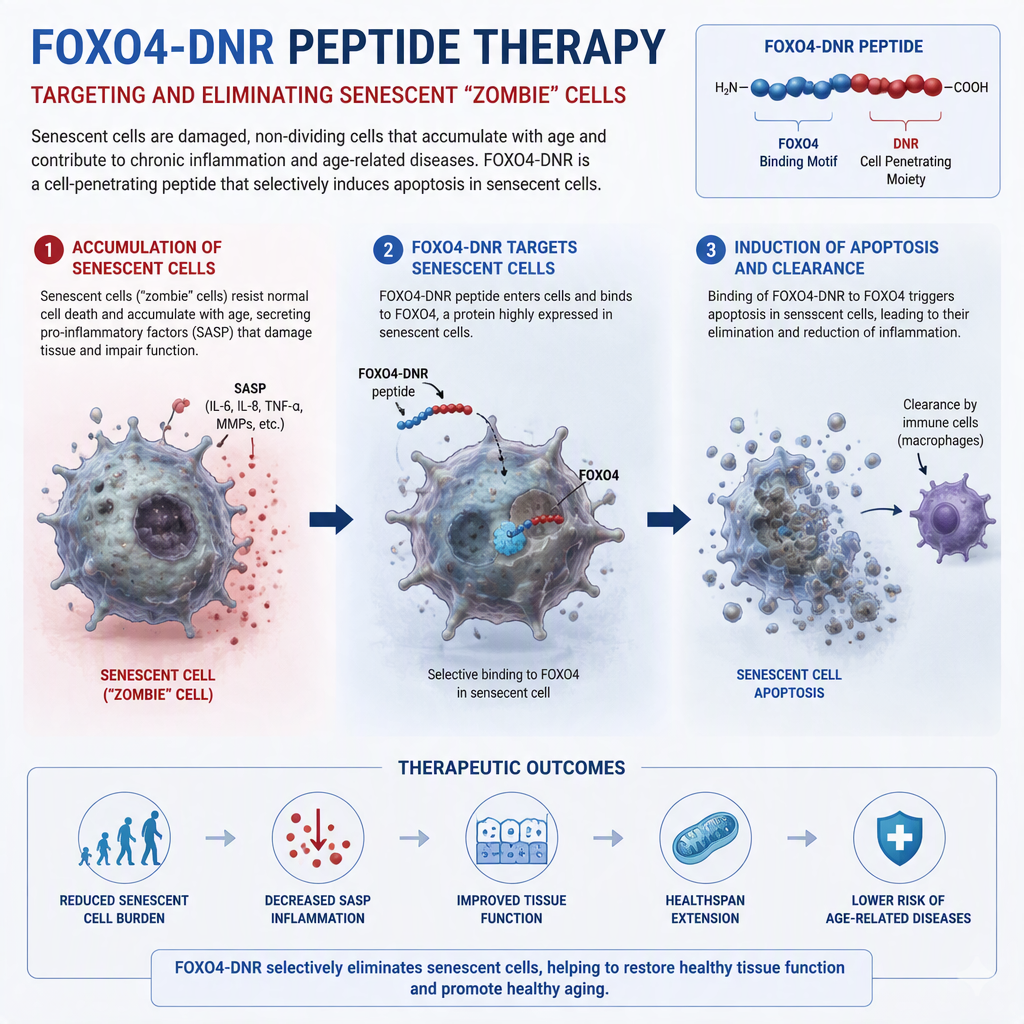
As we age, our bodies accumulate cells that should have died but didn’t. These are called senescent cells—and they’re one of the primary drivers of aging and age-related disease.
Browse our full peptide catalog
Most longevity research focuses on making healthy cells perform better. FOXO4-DNR takes a completely different approach: eliminating cells that shouldn’t exist.
What Are Senescent Cells?
Senescent cells are cells that have entered a state of permanent growth arrest. They’ve stopped dividing but refused to undergo apoptosis (programmed cell death).
Why Cells Become Senescent
| Trigger | Mechanism | Result |
|---|---|---|
| Telomere shortening | Replicative exhaustion | Natural aging |
| DNA damage | Irreparable mutations | Cancer prevention gone wrong |
| Oxidative stress | Mitochondrial dysfunction | Cellular aging |
| Epigenetic changes | Gene expression alterations | Loss of identity |
| Oncogene activation | Uncontrolled growth signals | Tumor suppression response |
The SASP: What Makes Them Dangerous
Senescent cells don’t just sit there harmlessly. They secrete the Senescence-Associated Secretory Phenotype (SASP)—a cocktail of pro-inflammatory cytokines, chemokines, proteases, and growth factors.
The SASP includes:
– IL-6, IL-1β (inflammatory cytokines)
– TNF-α (tumor necrosis factor)
– MMPs (matrix metalloproteinases that degrade tissue)
– VEGF (vascular endothelial growth factor)
– PAI-1 (plasminogen activator inhibitor)
This inflammatory soup does three things:
1. Recruits immune cells that fail to clear the senescent cells
2. Damages nearby healthy tissue through chronic inflammation
3. Induces senescence in neighboring cells (bystander effect)
The result is a self-perpetuating cycle of cellular aging and tissue dysfunction.
The FOXO4-p53 Interaction
Normal Cell Death Pathway
In healthy cells, damage triggers p53 activation, which leads to:
1. Cell cycle arrest (repair attempt)
2. If repair fails → apoptosis (programmed death)
3. Clean removal by immune cells
How Senescent Cells Evade Death
Senescent cells activate FOXO4 transcription factors, which:
– Bind to p53 and inhibit its pro-apoptotic function
– Upregulate anti-apoptotic genes (BCL-2, BCL-xL)
– Maintain survival signaling despite severe damage
This is the “do not delete” lock that keeps zombie cells alive.
How FOXO4-DNR Works
The Peptide Design
FOXO4-DNR is a cell-penetrating peptide derived from the FOXO4 DNA-binding domain. It’s designed to:
1. Enter cells efficiently (cell-penetrating property)
2. Disrupt the FOXO4-p53 interaction specifically
3. Restore p53’s ability to trigger apoptosis in senescent cells
The Mechanism
- FOXO4-DNR enters senescent cells
- Binds to FOXO4, preventing it from interacting with p53
- Releases the “brake” on p53
- p53 can now trigger apoptosis
- Senescent cells die and are cleared
Selectivity: Why It Targets Senescent Cells
Normal cells have functional apoptosis pathways that don’t rely on FOXO4-p53 interaction. Only senescent cells depend on this specific interaction to survive. FOXO4-DNR disrupts the one pathway senescent cells need while leaving normal cell death mechanisms intact.
Research Findings
Animal Studies
| Study | Finding | Significance |
|---|---|---|
| Zhang et al., 2018 | FOXO4-DNR cleared senescent cells in aged mice | First demonstration of senolytic peptide |
| Same study | Improved fertility in aged males | Functional benefit beyond cell clearance |
| Follow-up studies | Reduced inflammation, improved tissue function | Mechanistic validation |
Key Outcomes
- Senescent cell clearance: 40-60% reduction in targeted tissues
- Functional improvement: Enhanced physical activity, faster wound healing
- Inflammation reduction: Lower SASP markers in blood
- Lifespan extension: Modest but significant in some models
Safety Considerations
The Theoretical Risks
FOXO4 and p53 are involved in critical cellular processes:
– Cancer suppression: p53 prevents tumor formation
– Stem cell maintenance: FOXO4 supports tissue regeneration
– Stress response: Both involved in cellular adaptation
Disrupting these pathways long-term carries theoretical risks.
What We Know
- Acute dosing appears safe in animal studies
- Clearance is rapid — peptide half-life is short
- No cancer promotion observed in studies to date
- Repeated dosing safety data is limited
What We Don’t Know
- Long-term repeated dosing effects
- Impact on stem cell compartments
- Effects in humans with different genetics
- Potential for immune reactions to the peptide
FOXO4-DNR vs Other Senolytics
| Compound | Mechanism | Status | Advantages | Limitations |
|---|---|---|---|---|
| FOXO4-DNR | Disrupts FOXO4-p53 | Preclinical | Targeted, peptide-based | Limited human data |
| Dasatinib + Quercetin | Apoptosis induction | Human trials | Oral, accessible | Off-target effects |
| Fisetin | Natural flavonoid | Available OTC | Safe, accessible | Less potent |
| Navitoclax | BCL-2 inhibition | Clinical | Potent | Thrombocytopenia |
FOXO4-DNR represents a more targeted approach than drug combinations, but human data is still needed.
The Future of Senolytic Therapy
Where Research Is Headed
- Improved delivery: Better tissue targeting, sustained release
- ** Combination protocols**: FOXO4-DNR + fisetin for enhanced clearance
- Personalized dosing: Based on senescent cell burden markers
- Clinical trials: Early-phase studies anticipated within 2-3 years
Practical Timeline
| Phase | Expected Timeline | What to Expect |
|---|---|---|
| Preclinical optimization | 2024-2025 | Better formulations, toxicity studies |
| Phase 1 trials | 2025-2026 | Safety in healthy volunteers |
| Phase 2 trials | 2026-2028 | Efficacy in aging indications |
| Potential approval | 2028-2030 | If Phase 3 successful |
The Bottom Line
FOXO4-DNR represents a promising new class of senolytic therapy—one that specifically targets the molecular mechanism keeping zombie cells alive. While animal data is encouraging, human trials are needed before this can be recommended.
For now, established senolytics like fisetin remain the practical choice for those interested in intermittent senescent cell clearance. FOXO4-DNR is a future possibility worth watching.
Disclaimer: FOXO4-DNR is experimental and not approved for human use. This article is for informational purposes only. Consult a healthcare provider before considering any senolytic compound.