Published on PeptideLab | Read time: 9 min | Last updated: October 2026
The Hair Loss Problem
Hair loss affects millions of people worldwide. While many treatments exist, GHK-Cu has emerged as a promising option with a unique mechanism of action.
Browse our full peptide catalog
How GHK-Cu Works for Hair
Follicle Remodeling
GHK-Cu can “remodel” hair follicles—essentially reversing some age-related follicle miniaturization. This is particularly relevant for androgenetic alopecia (pattern hair loss).
The Mechanism:
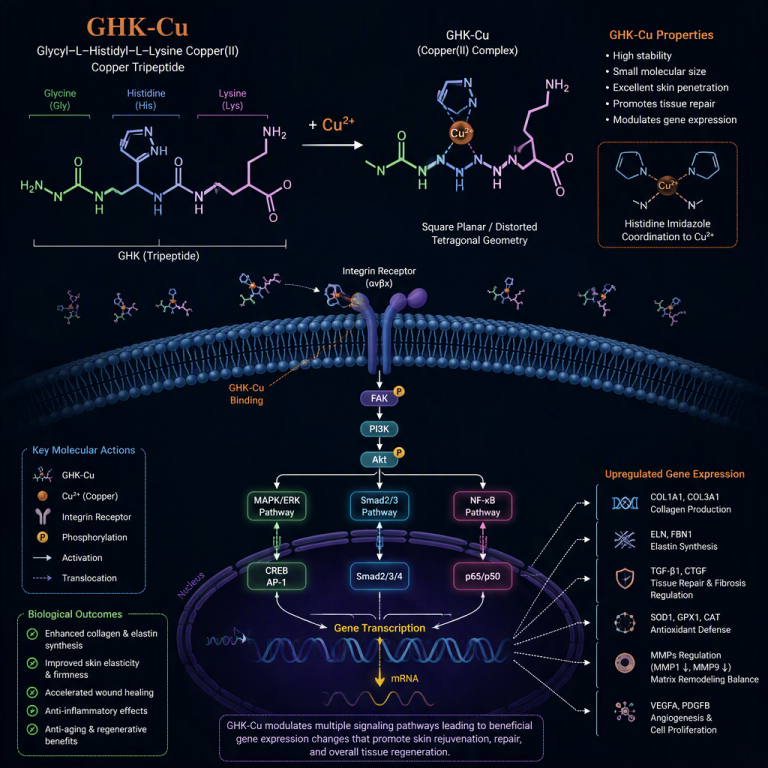
– GHK-Cu stimulates fibroblast activity in the hair follicle dermal papilla
– Promotes production of growth factors (VEGF, FGF)
– Enhances angiogenesis around follicles
– Supports stem cell activity in the hair bulb
Angiogenesis
GHK-Cu promotes the formation of new blood vessels around hair follicles. Better blood supply means:
– More nutrients delivered to the follicle
– Better waste removal
– Improved follicle health and function
– Extended anagen (growth) phase
Inflammation Reduction
Chronic inflammation around hair follicles can contribute to hair loss. GHK-Cu’s anti-inflammatory properties may help create a healthier scalp environment by:
– Reducing pro-inflammatory cytokines
– Supporting proper immune response
– Creating favorable conditions for growth
The Research
Animal Studies
| Study | Finding | Significance |
|---|---|---|
| Tsuboi et al. | Significant hair regrowth in Alopecia areata models | First demonstration of efficacy |
| Various studies | Improved hair thickness and density | Consistent positive results |
| Topical application | Enhanced follicle size and activity | Direct follicle stimulation |
Human Evidence
While large-scale human trials are limited, case studies and small trials show:
– Reduced hair shedding
– Improved hair thickness
– New hair growth in some individuals
– Better response when combined with other treatments
How to Use GHK-Cu for Hair
Topical Application
Product Selection:
– Look for 1-3% GHK-Cu concentration
– Serum or solution format preferred
– Alcohol-free for sensitive scalps
Application Protocol:
– Concentration: 1-3% GHK-Cu solutions
– Frequency: Once or twice daily
– Method: Apply directly to scalp, massage in
– Timeline: 3-6 months for visible results
– Consistency: Daily application essential
Best Practices:
– Apply to clean, dry scalp
– Massage gently for 2-3 minutes
– Allow to absorb before styling
– Consistency is key—daily use required
Injectable Approach
Some practitioners recommend low-dose injections for more systemic effects:
– Dose: 0.5-1 mg subcutaneously
– Frequency: 2-3 times per week
– Sites: Abdomen or dedicated injection sites
– Note: Should only be done under medical supervision
Stacking for Enhanced Results
| Compound | Synergy | Mechanism |
|---|---|---|
| Minoxidil | Different mechanism, complementary effects | Vasodilation, potassium channel opening |
| Finasteride | Addresses hormonal cause (if applicable) | 5-alpha reductase inhibition |
| Ketoconazole shampoo | Anti-fungal, anti-inflammatory | Reduces scalp inflammation |
| Microneedling | Enhances absorption, stimulates healing | Mechanical stimulation + peptide delivery |
| Niacinamide | Improved barrier function | Vitamin B3, circulation support |
| Caffeine | Follicle stimulation | Adenosine receptor antagonism |
Recommended Stacking Protocol
| Time | Product | Purpose |
|---|---|---|
| Morning | GHK-Cu serum + Minoxidil | Dual mechanism stimulation |
| Evening | GHK-Cu serum | Continued support |
| 2-3x/week | Microneedling (0.5-1.0 mm) | Enhanced absorption |
| Daily | Ketoconazole shampoo (2-3x/week) | Scalp health |
Realistic Expectations
| Timeline | What to Expect |
|---|---|
| Month 1-2 | Reduced shedding, improved scalp health |
| Month 3-4 | Early regrowth begins, improved thickness |
| Month 5-6 | Visible results, continued improvement |
| Month 6+ | Maximum results, maintenance phase |
Important Notes:
– Results vary by individual
– Consistency is essential
– Best results in early-stage hair loss
– Combination therapy often more effective than monotherapy
Who Benefits Most?
| Candidate Type | Expected Response | Notes |
|---|---|---|
| Early-stage hair loss | Good | Within first few years of loss |
| Androgenetic alopecia (male) | Moderate to good | Works best combined with finasteride |
| Androgenetic alopecia (female) | Good | Often first-line treatment |
| Post-partum hair loss | Excellent | Temporary loss responds well |
| Age-related thinning | Moderate | Slower response, needs patience |
| Alopecia areata | Variable | Autoimmune, may need additional treatment |
Safety and Side Effects
Generally Well-Tolerated:
– Minimal side effects with topical use
– No systemic absorption concerns
– Safe for long-term use
– No known drug interactions
Possible Issues:
– Scalp irritation (rare)
– Contact dermatitis (very rare)
– Initial shedding phase (temporary)
The Bottom Line
GHK-Cu offers a unique approach to hair growth through follicle remodeling, angiogenesis, and inflammation reduction. While not a miracle cure, it represents a promising option—especially for those seeking alternatives to pharmaceutical treatments or looking to enhance existing protocols.
Best results come from:
1. Early intervention
2. Consistent daily application
3. Combination with other evidence-based treatments
4. Patience (minimum 6 months)
Disclaimer: Consult a healthcare provider or dermatologist before starting any hair loss treatment. This article is for informational purposes only.