Published on PeptideLab | Read time: 10 min | Last updated: October 2026
The Overlap That Confuses People
Glutathione and SS31 both get discussed for oxidative stress. They share a goal—protecting cells from damage—but achieve it through completely different mechanisms.
Browse our full peptide catalog
Understanding the difference leads to better supplementation strategy.
What Is Glutathione?
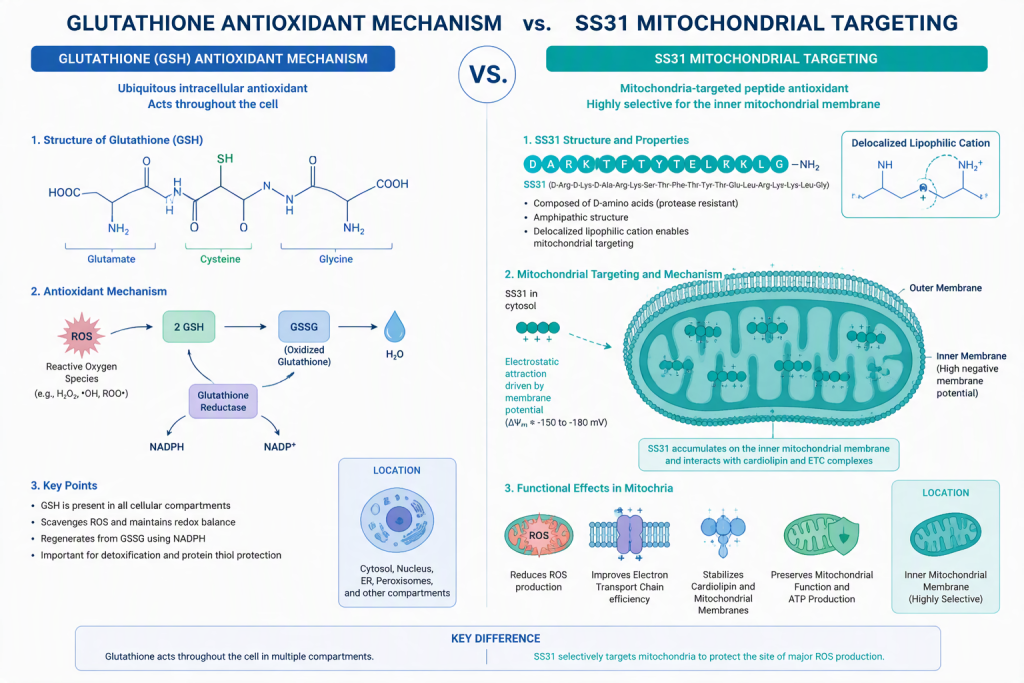
Glutathione is your body’s master antioxidant—a tripeptide (glycine, glutamate, cysteine) produced in every cell.
How It Works:
| Function | Mechanism | Impact |
|---|---|---|
| Direct ROS neutralization | Thiol group donates electrons to free radicals | Primary defense against oxidative damage |
| Antioxidant recycling | Regenerates vitamins C and E | Amplifies overall antioxidant capacity |
| Detoxification support | Conjugates with toxins for excretion | Liver detoxification pathway |
| Immune modulation | Supports lymphocyte function | Immune system optimization |
When oxidative stress builds up, glutathione helps clean up the damage. It’s your first line of defense—broad, flexible, and always active.
The Glutathione Challenge
Despite its importance, maintaining optimal glutathione levels is difficult:
– Oral absorption is poor — Most is degraded in the gut
– Levels decline with age — Natural production decreases
– Stress depletes stores — Chronic stress accelerates utilization
– Detoxification demands — Environmental toxins consume reserves
Common strategies to support glutathione include NAC (N-acetylcysteine) supplementation, liposomal glutathione, and precursor support.
What Is SS31 (Elamipretide)?
SS31 is a mitochondria-targeted peptide designed to concentrate specifically inside mitochondria.
The Target: Cardiolipin
Cardiolipin is a unique phospholipid found almost exclusively in the inner mitochondrial membrane. It’s critical because:
– It holds the electron transport chain (ETC) complexes together
– It maintains the structural integrity needed for efficient ATP production
– It prevents electron “leakage” that generates reactive oxygen species (ROS)
How SS31 Works
When cardiolipin is damaged (by aging, stress, or disease):
1. The ETC becomes inefficient
2. Electrons leak out of the chain
3. These electrons react with oxygen, creating superoxide (a potent ROS)
4. This oxidative damage further damages cardiolipin—a vicious cycle
SS31 breaks this cycle by:
– Binding to cardiolipin
– Stabilizing ETC architecture
– Reducing electron leakage
– Improving ATP production efficiency
– Decreasing ROS generation at the source
The Fundamental Difference
| Aspect | Glutathione | SS31 |
|---|---|---|
| Target | General cellular antioxidant defense | Mitochondrial membrane structure |
| Action | Neutralizes existing ROS | Prevents ROS generation |
| Location | Cytosol, extracellular, all compartments | Inner mitochondrial membrane |
| Analogy | Fire department responding to fires | Fire prevention through electrical safety |
Glutathione strengthens the antioxidant system that deals with oxidative stress after it occurs.
SS31 goes to one of the major cellular sources of oxidative stress—the mitochondria—and improves how they function in the first place.
Why Both Matter
They’re not interchangeable. They’re complementary.
The Glutathione Gap
Even with optimal glutathione levels, if mitochondria are producing excessive ROS due to cardiolipin damage, you’re constantly playing catch-up. Glutathione gets consumed faster than it can be regenerated.
The SS31 Gap
Without adequate glutathione, even optimized mitochondria face oxidative stress from other sources—inflammation, environmental toxins, metabolic byproducts. SS31 doesn’t replace general antioxidant defenses.
The Synergy
When combined:
1. SS31 reduces ROS production at the mitochondrial level
2. Glutathione neutralizes any ROS that still gets produced
3. Both support each other’s recycling — glutathione supports sirtuin activity, which supports mitochondrial biogenesis
This addresses oxidative stress at multiple levels simultaneously.
Clinical Applications
| Condition | Glutathione Benefit | SS31 Benefit | Combined Approach |
|---|---|---|---|
| Aging | General antioxidant support | Mitochondrial optimization | Comprehensive protection |
| Neurodegeneration | Neuroprotection | Mitochondrial brain support | Dual mechanism |
| Cardiovascular | Vascular health | Cardiac mitochondrial support | Heart protection |
| Exercise recovery | Reduced muscle damage | Enhanced mitochondrial biogenesis | Better performance |
| Metabolic syndrome | Insulin sensitivity | Mitochondrial function | Metabolic optimization |
Practical Comparison
| Factor | Glutathione | SS31 |
|---|---|---|
| Administration | Oral (low bioavailability), IV, liposomal, NAC precursor | Subcutaneous injection |
| Evidence | Extensive human safety data | Growing clinical evidence |
| Cost | Generally lower | Higher per dose |
| Best for | General antioxidant support, detox, aging | Mitochondrial-specific optimization |
| Onset | Gradual (weeks) | Faster (days to weeks) |
Who Should Consider Which?
| Profile | Recommendation |
|---|---|
| General antioxidant support | Glutathione (or NAC precursor) |
| Mitochondrial concerns | SS31 |
| Both | Stack both for comprehensive coverage |
| Detox support | Glutathione |
| Exercise recovery | Both |
| Age-related decline | Both |
| Budget conscious | Glutathione/NAC |
| Advanced protocol | Both stacked |
The Bottom Line
Glutathione is your broad-spectrum antioxidant defense. SS31 is your targeted mitochondrial optimizer. One cleans up the mess; the other prevents the mess from happening. Using both addresses oxidative stress at its source and its consequences—a strategy far more effective than relying on either alone.
Similar goal. Completely different approach. Together, they cover the full spectrum.
Disclaimer: This article is for informational purposes only. SS31 is a prescription medication in some jurisdictions. Consult a healthcare provider before use.