Published on PeptideLab | Read time: 9 min | Last updated: October 2026
The Overwhelming Options
The peptide space offers dozens of compounds for various goals. Without a framework, it’s easy to get overwhelmed or make poor choices.
Browse our full peptide catalog
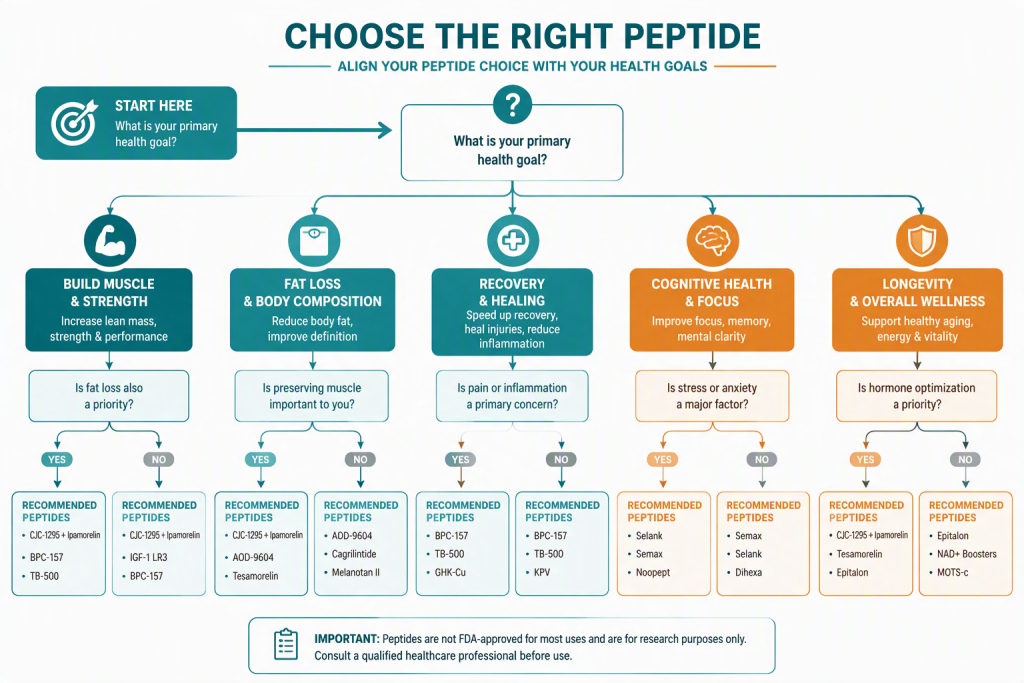
Here’s a step-by-step decision framework.
Step 1: Define Your Primary Goal
Be specific. “Get healthier” is too vague.
| Goal Category | Specific Examples |
|---|---|
| Weight loss | Reduce appetite, increase metabolism, lose visceral fat |
| Recovery | Heal injury, reduce inflammation, repair tissue |
| Anti-aging | Improve skin, enhance longevity, clear senescent cells |
| Performance | Build muscle, improve endurance, enhance recovery |
| Cognitive | Improve focus, memory, neuroprotection |
| Immune | Boost immunity, reduce inflammation |
Your goal determines which peptide categories to explore.
Step 2: Understand the Mechanism
For your chosen goal, research the mechanisms involved.
| Goal | Key Mechanisms | Relevant Peptides |
|---|---|---|
| Weight loss | GLP-1/GIP/glucagon receptors | Retatrutide, tirzepatide |
| Recovery | Angiogenesis, fibroblast activation | BPC-157, TB-500 |
| Skin health | Collagen synthesis, gene expression | GHK-Cu |
| Longevity | Senolytic clearance | FOXO4-DNR |
| Energy | Mitochondrial function, AMPK | MOTS-c, SS31 |
Understanding mechanism helps you evaluate claims and set realistic expectations.
Step 3: Evaluate the Evidence
Not all peptides have the same evidence base.
| Evidence Level | Examples | Confidence |
|---|---|---|
| Strong human data | GHK-Cu, BPC-157 (some), retatrutide | High |
| Moderate human data | Motilin, thymosin | Medium |
| Mostly animal data | FOXO4-DNR, SS31 | Lower |
| Purely preclinical | Many newer peptides | Speculative |
Prioritize peptides with stronger evidence for your primary goal.
Step 4: Consider Safety
| Factor | Question to Ask |
|---|---|
| Side effects | What are the known side effects? |
| Interactions | Does it interact with medications? |
| Contraindications | Who should avoid it? |
| Quality | Is it from a reputable source? |
| Administration | How is it delivered? |
Start with peptides that have excellent safety profiles.
Step 5: Think About Stacking
Some peptides work better together. Others are redundant.
| Stack Example | Rationale |
|---|---|
| GHK-Cu + BPC-157 | Skin + tissue repair synergy |
| MOTS-c + NAD+ | Mitochondrial signaling + substrate |
| Retatrutide + lifestyle | Medication + behavior change |
| FOXO4-DNR + fisetin | Complementary senolytics |
Don’t stack randomly—have a rationale for each combination.
Step 6: Monitor and Adjust
Track your results objectively:
| Metric | How to Track |
|---|---|
| Weight | Weekly average, same time/day |
| Body composition | Waist measurement, photos |
| Energy | Daily rating scale |
| Sleep | Quality score, hours |
| Blood work | Quarterly comprehensive panel |
Adjust based on data, not feelings alone.
Quick Decision Matrix
| If your goal is… | Start with… | Then consider… |
|---|---|---|
| Weight loss | Retatrutide (if available) | Lifestyle optimization |
| Recovery | BPC-157 | TB-500, GHK-Cu |
| Skin | GHK-Cu | Collagen peptides, vitamin C |
| Longevity | Fisetin, metformin | FOXO4-DNR (when available) |
| Energy | MOTS-c, NAD+ precursors | Exercise, sleep optimization |
| Cognitive | Semax, Selank | Lifestyle, diet |
The Bottom Line
Choosing the right peptide isn’t about finding the “best” compound—it’s about finding the right compound for your specific goal, with adequate evidence, acceptable safety, and a clear monitoring plan.
Start simple. One peptide at a time. Track results. Adjust based on data.
Disclaimer: This article is for informational purposes only. Consult a healthcare provider before starting any peptide protocol.