Published on PeptideLab | Read time: 8 min | Last updated: October 2026
What Are Peptides?
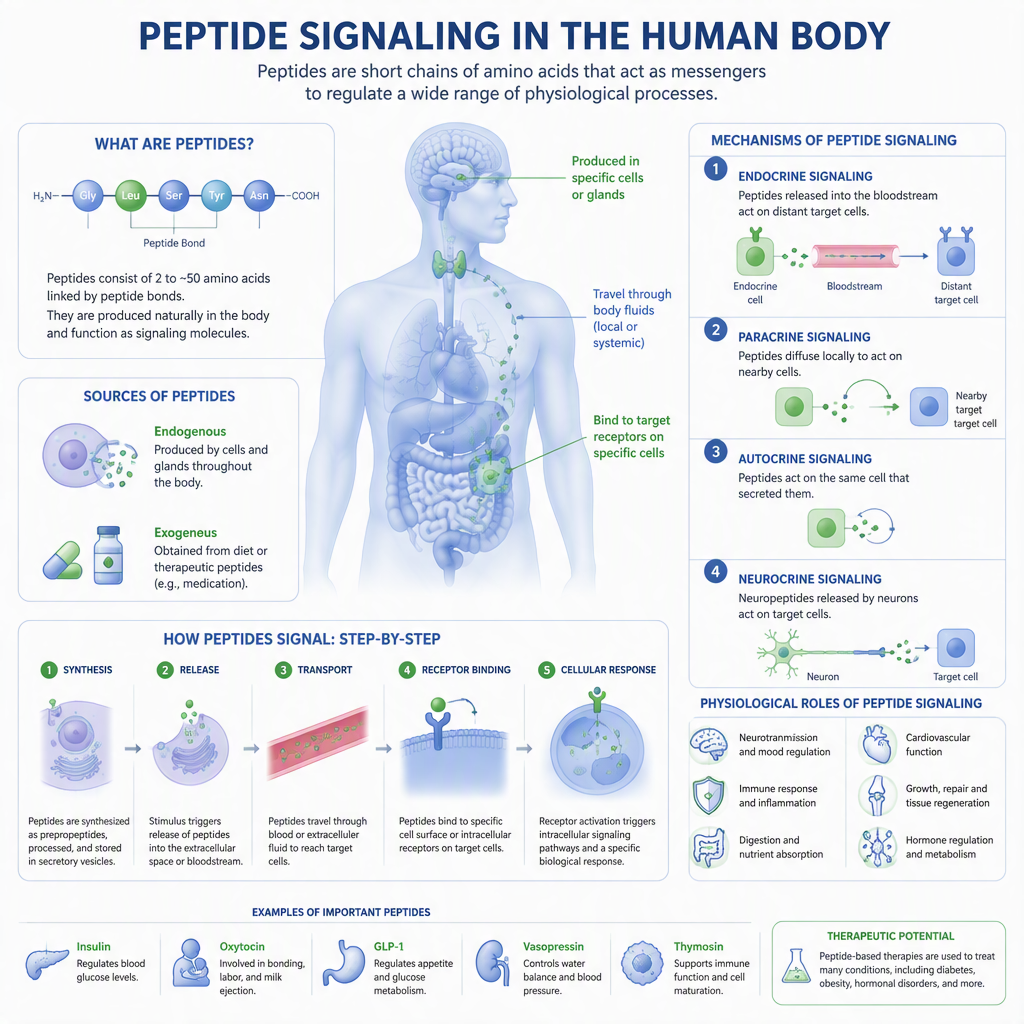
Peptides are short chains of amino acids—the same building blocks that make up proteins. But calling peptides “tiny proteins” misses what makes them interesting.
Peptides aren’t just structural components floating around doing nothing. Most of them act as signals.
The Communication Network Analogy
Think of your body as a massive communication network. Cells are constantly sending messages to other cells, telling them what to do, when to do it, and when to stop.
Peptides are part of that conversation.
Different peptides send completely different signals:
– Some tell cells to release growth hormone
– Some signal tissue repair pathways
– Some modulate immune responses
– Some influence metabolism
– Some affect brain function
Peptide vs Protein: What’s the Difference?
| Feature | Peptide | Protein |
|---|---|---|
| Chain length | 2-50 amino acids | 50+ amino acids |
| Structure | Simpler | Complex 3D folding |
| Absorption | Better oral bioavailability (some) | Poor oral bioavailability |
| Function | Often signaling | Structural + signaling |
| Examples | BPC-157, GHK-Cu | Collagen, enzymes |
How Peptides Work
Peptides function as molecular messengers:
- Production: Either naturally produced by your body or synthesized in a lab
- Release: Secreted into bloodstream or local tissue
- Binding: Attach to specific receptors on target cells
- Signal transduction: Trigger intracellular pathways
- Response: Cell changes behavior (grows, repairs, divides, etc.)
This is fundamentally different from how most pharmaceuticals work—peptides tend to be more specific and work with your body’s natural signaling systems.
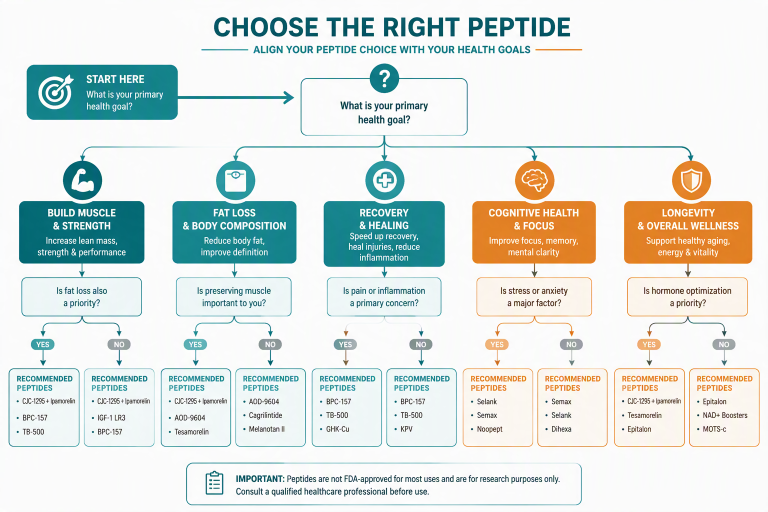
Common Peptide Categories
| Category | Examples | Primary Use |
|---|---|---|
| Growth hormone secretagogues | Tesamoreline, CJC-1295, Ipamorelin | GH release, body composition |
| Recovery peptides | BPC-157, TB-500 | Tissue healing, injury repair |
| Cosmetic peptides | GHK-Cu, Matrixyl | Skin, hair, collagen |
| Metabolic peptides | Retatrutide, MOTS-c | Weight loss, energy |
| Immune peptides | Thymosin alpha-1 | Immune modulation |
| Neuroprotective peptides | Semax, Selank | Brain health, cognition |
| Senolytic peptides | FOXO4-DNR | Clear senescent cells |
The Right Way to Think About Peptides
Instead of memorizing 50 different peptide names and their claimed effects, start with one question:
“What signal is this peptide sending, and which pathway is receiving it?”
Every peptide has a specific mechanism. Understanding the mechanism tells you:
– What it’s likely to affect
– What results to expect
– What limitations to anticipate
– How it might interact with other compounds
Examples That Illustrate the Point
| Peptide | Signal It Sends | Primary Pathway |
|---|---|---|
| BPC-157 | “Repair this damaged tissue” | Angiogenesis, fibroblast activation |
| Retatrutide | “Reduce appetite, increase energy expenditure” | GLP-1/GIP/glucagon receptors |
| GHK-Cu | “Remodel and regenerate this tissue” | Collagen synthesis, gene expression |
| MOTS-c | “Optimize energy production” | AMPK activation, mitochondrial function |
| Tesamoreline | “Release more growth hormone” | GHRH receptor activation |
Same word—completely different messages.
Why This Matters for You
The peptide space is full of hype, oversimplification, and misleading claims. When someone says “peptides help with X,” the real question is:
Which peptide? Through what mechanism? With what evidence?
Understanding that peptides are signaling molecules—not a monolithic category with uniform effects—helps you cut through the noise. It lets you evaluate each compound on its own merits rather than assuming one peptide’s reputation applies to all of them.
https://linktr.ee/peptidecatalog
Getting Started Safely
- Educate yourself on mechanisms, not just marketing
- Consult a healthcare provider familiar with peptide therapy
- Start with well-studied peptides (GHK-Cu, BPC-157)
- Introduce one at a time to assess response
- Track outcomes objectively (measurements, blood work)
- Prioritize quality sourcing from reputable suppliers
The Takeaway
Peptides aren’t one specific treatment. They aren’t one category of effects. They’re messenger molecules—diverse, specific, and mechanism-driven.
Once you understand that framework, the whole peptide world becomes a lot easier to navigate. Stop memorizing names. Start understanding signals.
Disclaimer: This article is for informational purposes only and does not constitute medical advice. Peptide research is rapidly evolving. Consult a qualified healthcare provider for personal guidance.