Published on PeptideLab | Read time: 9 min
The Burning Question
Are we already saying goodbye to retatrutide because of UBT-251? Not so fast. But UBT-251 just made the triple agonist race a lot more competitive—and here’s what that means for everyone following obesity treatment.
Browse our full peptide catalog
What Is a Triple Agonist?
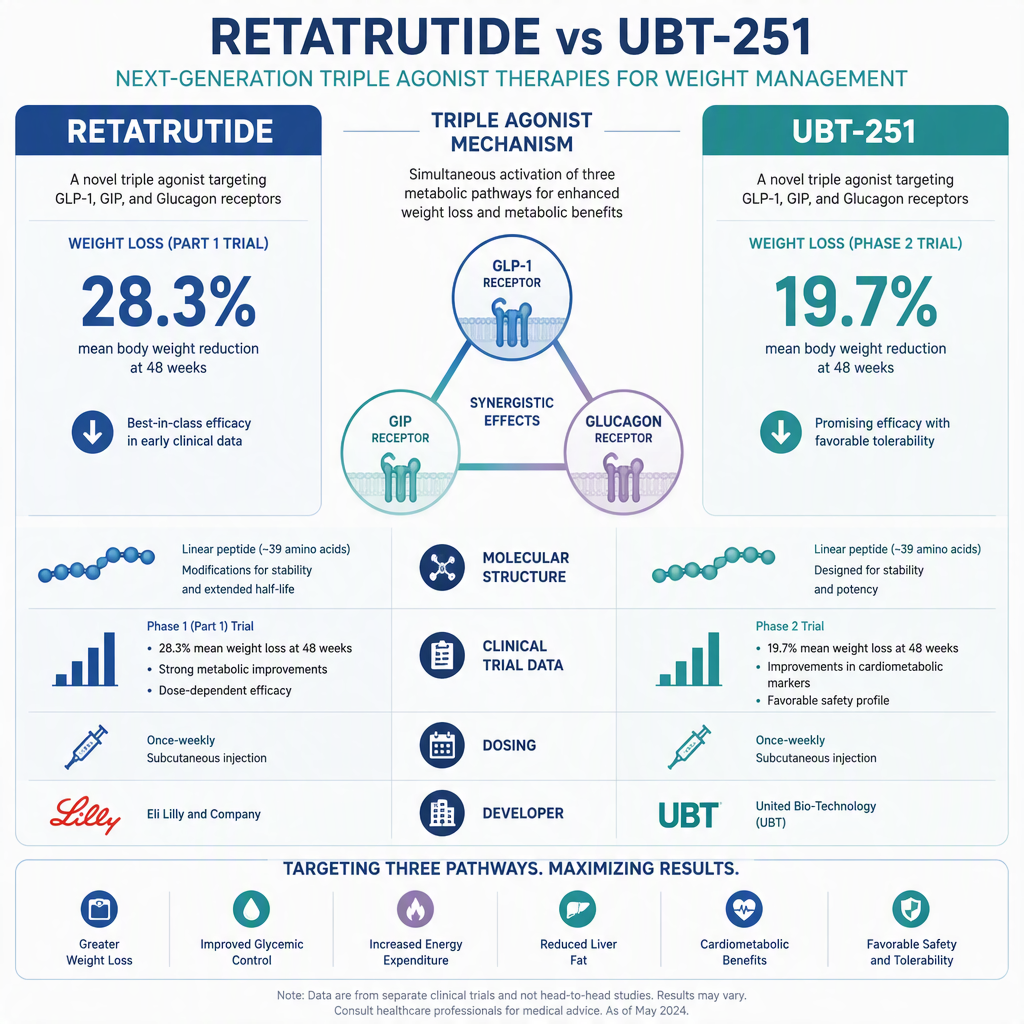
Both retatrutide and UBT-251 activate three incretin receptors simultaneously:
| Receptor | Function | Primary Effect |
|---|---|---|
| GLP-1 | Glucagon-like peptide-1 | Reduces appetite, slows gastric emptying |
| GIP | Glucose-dependent insulinotropic polypeptide | Supports insulin response, works with GLP-1 |
| Glucagon | Glucagon receptor | Increases energy expenditure, promotes fat burning |
This triple mechanism is what sets these compounds apart from single or dual agonists like semaglutide or tirzepatide.
Retatrutide: The Established Leader
Retatrutide (developed by Lilly) has the most advanced clinical data:
- Phase 3 results: 28.3% average weight loss over 80 weeks
- BMI ≥35 subgroup: Over 30% weight loss
- Extensive safety data: Large patient populations studied
- Longer trial duration: Nearly 2 years of data
UBT-251: The New Challenger
UBT-251 (developed by Umbra Therapeutics) entered with impressive Phase 2 data:
- Trial size: 205 overweight or obese participants
- Highest dose result: 19.7% average weight loss over 24 weeks
- Placebo comparison: ~2% weight loss
- Mechanism: Same triple agonist approach
Why You Can’t Declare a Winner Yet
You cannot fairly compare results from two separate clinical trials. The trials differed in fundamental ways:
| Factor | Retatrutide | UBT-251 |
|---|---|---|
| Duration | 80+ weeks | 24 weeks |
| Participants | Larger, diverse | Smaller, specific |
| Dosing | Gradual escalation | Different protocol |
| Starting BMI | Various thresholds | Specific criteria |
Where Retatrutide Still Leads
Retatrutide has more mature clinical data:
– Longer duration of follow-up
– Larger patient populations
– More comprehensive safety profiling
– Established dosing protocols
What This Means for Patients
| Consideration | Retatrutide | UBT-251 |
|---|---|---|
| Evidence maturity | More advanced | Earlier stage |
| Max weight loss | 28.3%+ | ~19.7% (Phase 2) |
| Availability | Closer to approval | Years away |
The Bottom Line
No, we’re not saying goodbye to retatrutide yet. It still holds the crown for the most robust triple agonist data available.
UBT-251 hasn’t replaced retatrutide. It’s a promising challenger with impressive Phase 2 results, but it needs larger, longer trials.
Competition between these two could push obesity treatment to entirely different levels. Watch for Phase 3 UBT-251 data.
Disclaimer: This article is for informational purposes only. Both compounds are investigational. Consult a qualified healthcare provider for treatment decisions.