Published on PeptideLab | Read time: 9 min | Last updated: October 2026
The Mitochondrial Connection
Mitochondria are the powerhouses of your cells—but they’re also a major source of oxidative stress. When they dysfunction, everything suffers.
Browse our full peptide catalog
SS31 (elamipretide) represents a targeted approach to mitochondrial optimization that goes beyond general antioxidant support.
What Are Mitochondria?
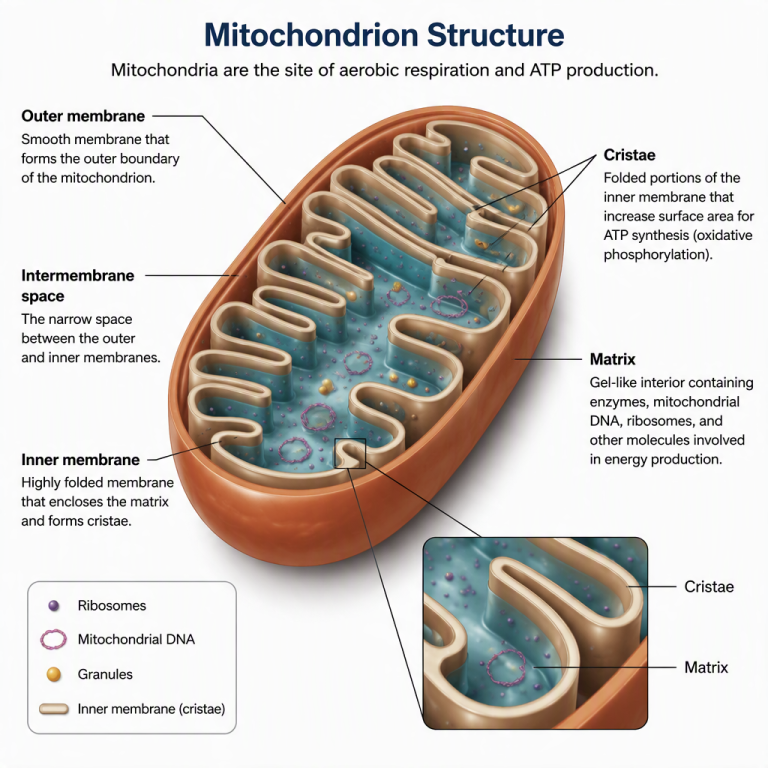
Mitochondria are double-membraned organelles found in almost all eukaryotic cells. Their primary function is ATP production through oxidative phosphorylation.
The Energy Production Process
- Electron Transport Chain (ETC): Four protein complexes pass electrons through the inner membrane
- Proton Gradient: Electron flow pumps protons across the membrane
- ATP Synthase: Protons flow back through ATP synthase, generating ATP
- Oxygen as Final Acceptor: Electrons combine with oxygen to form water
This process is incredibly efficient—but not perfect. Approximately 1-2% of electrons “leak” and react with oxygen to form superoxide, a potent reactive oxygen species (ROS).
The Cardiolipin Problem
Cardiolipin is a unique phospholipid found almost exclusively in the inner mitochondrial membrane. It’s critical because:
| Function | Importance |
|---|---|
| ETC organization | Holds complexes I, III, and IV in proper arrangement |
| Membrane curvature | Creates cristae structure for maximum surface area |
| Proton gradient maintenance | Prevents proton leak, ensures efficient ATP production |
| Apoptosis regulation | Involved in cell death signaling |
When cardiolipin is damaged (by aging, oxidative stress, or disease):
1. The ETC becomes inefficient
2. Electron leakage increases
3. ROS production escalates
4. Further cardiolipin damage occurs—a vicious cycle
How SS31 Works
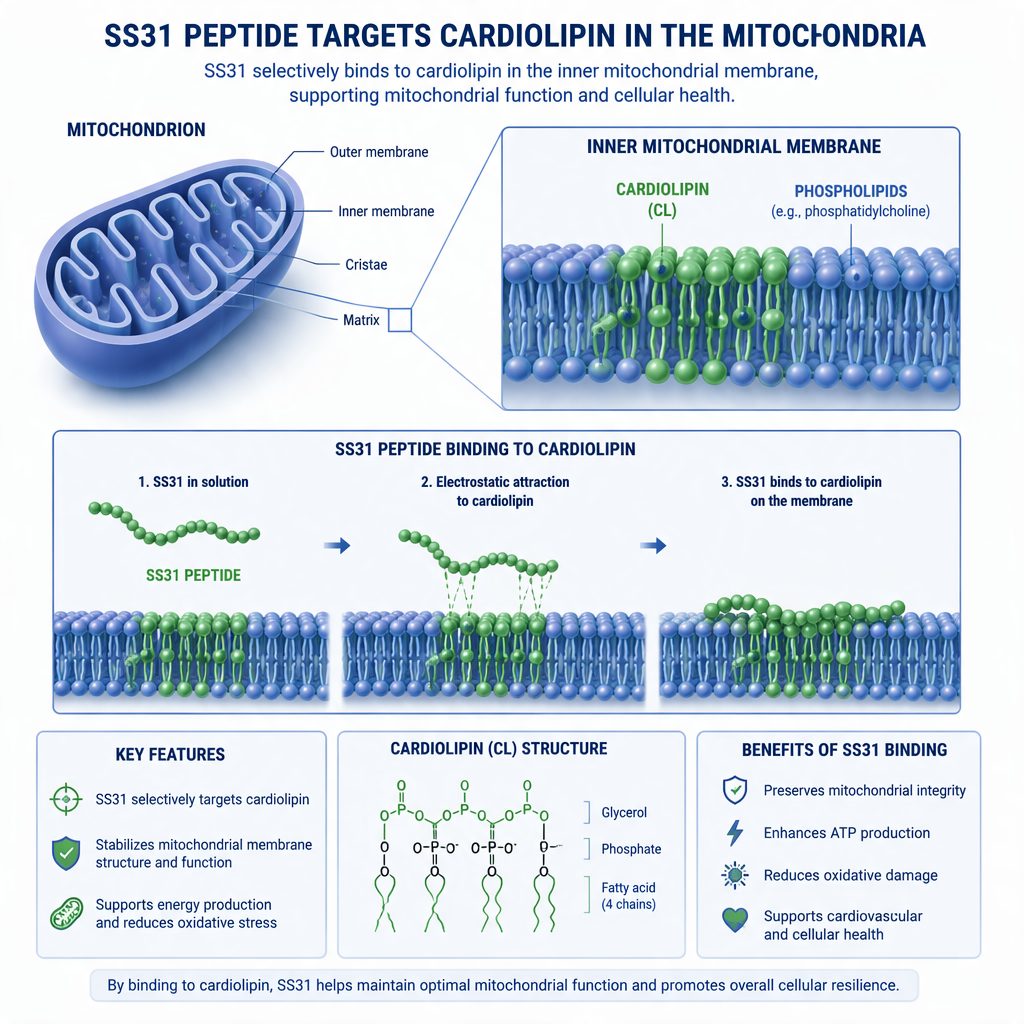
SS31 is a mitochondria-targeted peptide that concentrates specifically in the inner mitochondrial membrane. It was originally developed to treat mitochondrial myopathies—disorders caused by mitochondrial dysfunction.
The Mechanism
SS31 binds to cardiolipin and:
– Stabilizes ETC supercomplexes
– Reduces electron leakage
– Decreases ROS production
– Improves ATP synthesis efficiency
– Protects against cardiolipin peroxidation
Why This Matters
Most antioxidants address ROS after it’s produced. SS31 addresses one of the primary sources of ROS production—the mitochondria themselves.
What the Research Shows
Animal Studies
| Study | Finding | Significance |
|---|---|---|
| Mitochondrial myopathy models | Improved exercise capacity | Clinical translation potential |
| Aging models | Enhanced mitochondrial function | Age-related decline mitigation |
| Ischemia-reperfusion models | Cardioprotection | Heart attack protection |
| Neurodegeneration models | Neuroprotection | Alzheimer’s, Parkinson’s potential |
Human Studies
| Application | Results | Status |
|---|---|---|
| Mitochondrial myopathy | Improved exercise tolerance | FDA-approved |
| Cardiac surgery | Reduced cardiac injury | Clinical use |
| Renal protection | Reduced kidney injury markers | Research phase |
| Eye diseases | Retinal protection | Early research |
SS31 vs General Antioxidants
| Factor | General Antioxidants | SS31 |
|---|---|---|
| Target | Broad, systemic | Specific, mitochondrial |
| Mechanism | Neutralize existing ROS | Prevent ROS generation |
| Location | Throughout cell | Inner mitochondrial membrane |
| Analogy | Cleaning up spills | Fixing the leaking pipe |
General antioxidants deal with ROS after it’s produced. SS31 addresses one of the primary sources of ROS production.
Who Might Benefit?
| Population | Potential Benefit | Mechanism |
|---|---|---|
| Aging individuals | Mitochondrial decline reversal | Cardiolipin protection |
| Athletes | Enhanced recovery, performance | ATP optimization |
| Cardiac patients | Cardioprotection | Ischemia-reperfusion protection |
| Neurological conditions | Neuroprotection | Mitochondrial brain support |
| Metabolic disorders | Improved energy metabolism | Mitochondrial biogenesis |
| Chronic fatigue | Mitochondrial support | Energy production enhancement |
Dosing and Administration
SS31 is typically administered via subcutaneous injection. Common protocols range from 5-10 mg daily or every other day, though dosing should be determined by a healthcare provider based on individual needs.
Administration Considerations
- Route: Subcutaneous injection (abdomen, thigh, upper arm)
- Frequency: Daily or every other day
- Cycle: Typically 8-12 weeks on, 4 weeks off
- Monitoring: Track energy, recovery, cognitive function
Safety Profile
SS31 has an excellent safety profile in clinical studies:
– Well-tolerated at therapeutic doses
– Minimal side effects reported
– No significant drug interactions identified
– Long-term use appears safe
Reported side effects are rare and mild:
– Injection site reactions (rare)
– Mild headache (occasional)
– No serious adverse events in clinical trials
Stacking Considerations
| Stack | Synergy | Rationale |
|---|---|---|
| SS31 + CoQ10 | Enhanced ETC support | Both support electron transport |
| SS31 + PQQ | Mitochondrial biogenesis | PQQ promotes new mitochondria |
| SS31 + NAD+ precursors | Energy metabolism | NAD+ is essential for mitochondrial function |
| SS31 + Alpha-lipoic acid | Antioxidant support | Regenerated antioxidant cycle |
| SS31 + Omega-3 | Membrane health | Cardiolipin contains omega-3 fatty acids |
The Bottom Line
SS31 represents a fundamentally different approach to mitochondrial health—one that targets the root cause of mitochondrial-derived oxidative stress rather than just cleaning up the products. For anyone concerned with aging, performance, or mitochondrial health, SS31 offers a targeted, evidence-supported option.
While general antioxidants have their place, SS31 addresses the source of the problem. When mitochondria function optimally, oxidative stress decreases naturally, and the need for high-dose antioxidant supplementation may diminish.
Disclaimer: SS31 is a prescription medication. Consult a healthcare provider before use. This article is for informational purposes only.